Category Archives: Strider’s Log
Lionfish in the Eastern Caribbean by Owen
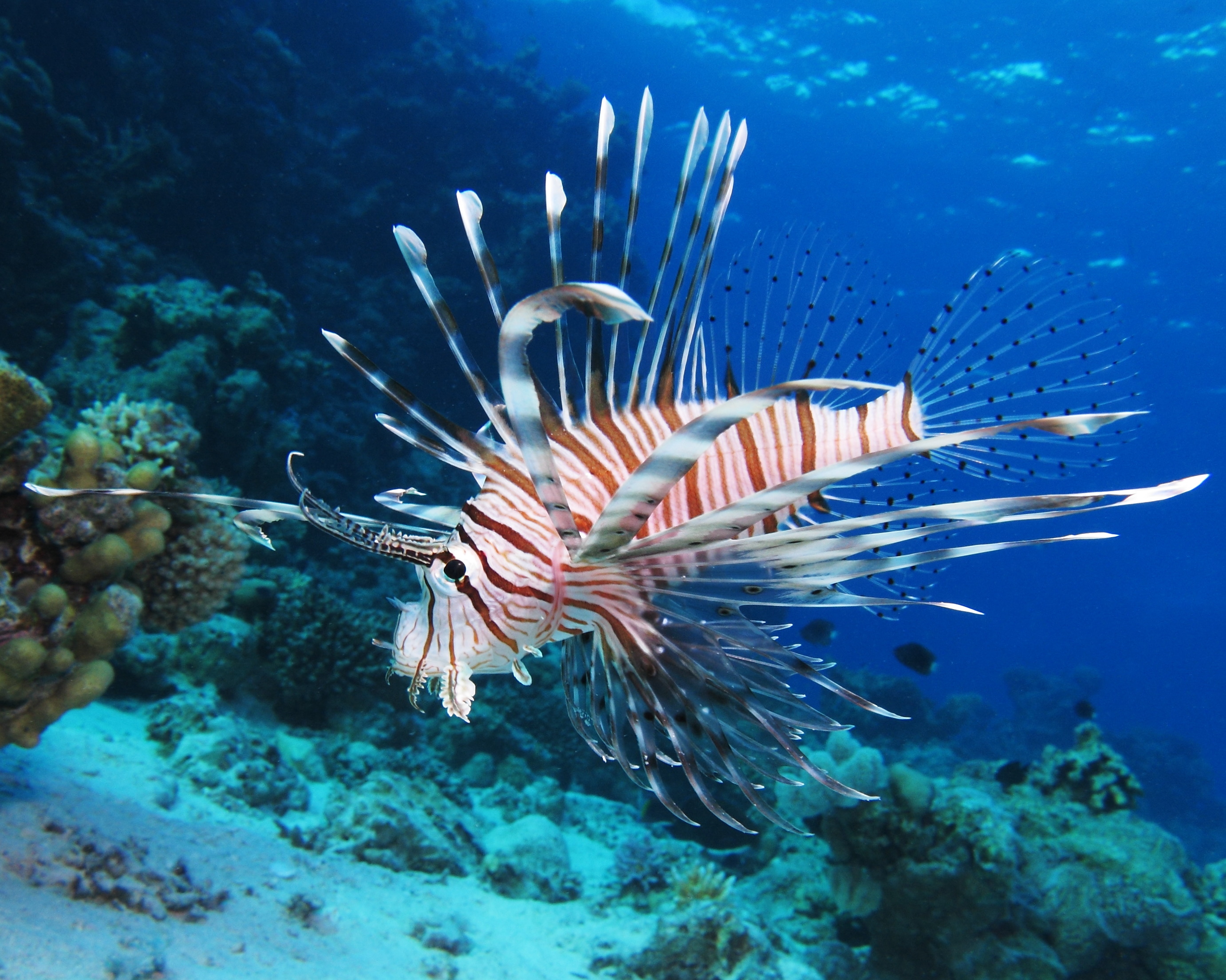
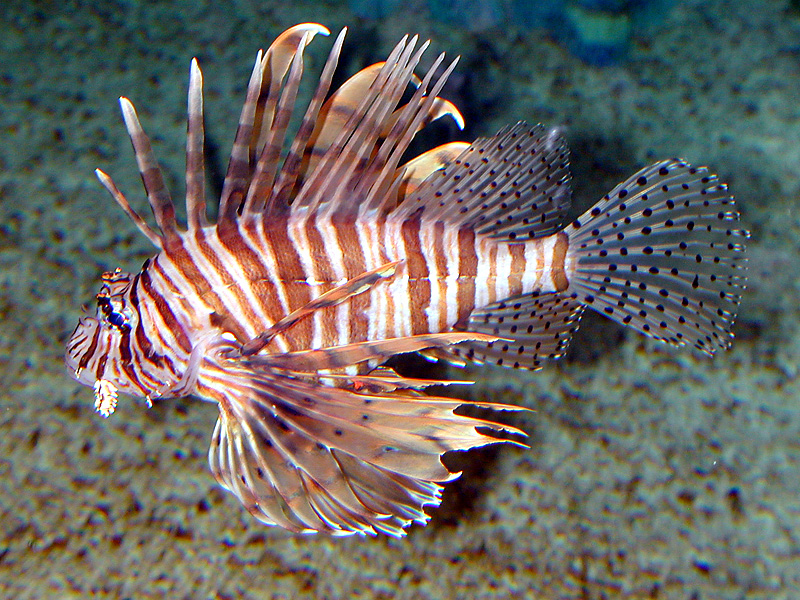
When I got to Deshaies on Guadeloupe, my dad and I saw three lion fish swimming around the mooring block we tied onto. But those were not the first I have seen on my trip aboard Strider. The first one I saw was when I went to Barbuda, when I was exploring a reef off of Spanish Point. The lionfish that I saw was in a crevice in the coral. I was so exited that I yelled, “lionfish”! As soon as I said that word, my sister screamed. I was so exited about the fish that I gave it a name, Spike. The reason I named him that is because I was so impressed with his fins and I thought his spikes were really cool. A lionfish is a type of fish that you don’t want to startle or touch. Their bodes are dark red with white zebra stripes, and they are covered with a layer of point like fins. These fins have venom in them, which ejects when touched. They are also not as slow or clumsy as they look. They are actually quite fast. But they are only fast for a short distance, which makes them easy to keep up with. When they swim fast, it is more like they are darting than swimming. These types of fish live in deep crevices in coral and rocks, which makes them difficult to spot.
Lionfish are an invasive species and we should do something about them. This type of fish was originally found in the Pacific Ocean, but it has spread, and they are now found throughout the Caribbean Sea, into the Gulf of Mexico and all the way up the East Coast as far north as Chesapeake Bay. They have also found a few of them in Connecticut and Rhode Island! The reason we need to do something about them is because lionfish have no natural predators and they eat any other fish up to 2/3rds of their own size. Since they have no predators, their populations is expanding and they are out competing other fish in the contest for food. If this continues, the lionfish will break the food eating world record, and other fish species will go extinct. I feel bad for the lionfish because people have been asked to kill them whenever they see them. If you are trying to kill one, I recommend going up quietly and using a long weapon. I would not advise trying to kill one with a weapon like a dagger. And most importantly, look out for the spikes. Would you like me to tell you what happens when you touch them? Ok, when touched, the spikes are not the only thing that causes injury. The venom also can cause nausea and breathing difficulties, but it is rarely fatal.
In the end, we know what will happen. Either lionfish will take over, or we will stop them. Since I am living on a boat, my family and I go out and explore lots of different reefs. And every place we go, when we go to a reef, I always look for lionfish and enjoy them because they look so much different from most of the fish I’ve seen. But I also think this…. It will be very hard to do something about them with so many and since they are hard to spot. But with the right gear and the right strategy, I know that there might be a way.
Joyeux Noel from Deshaies, Guadeloupe
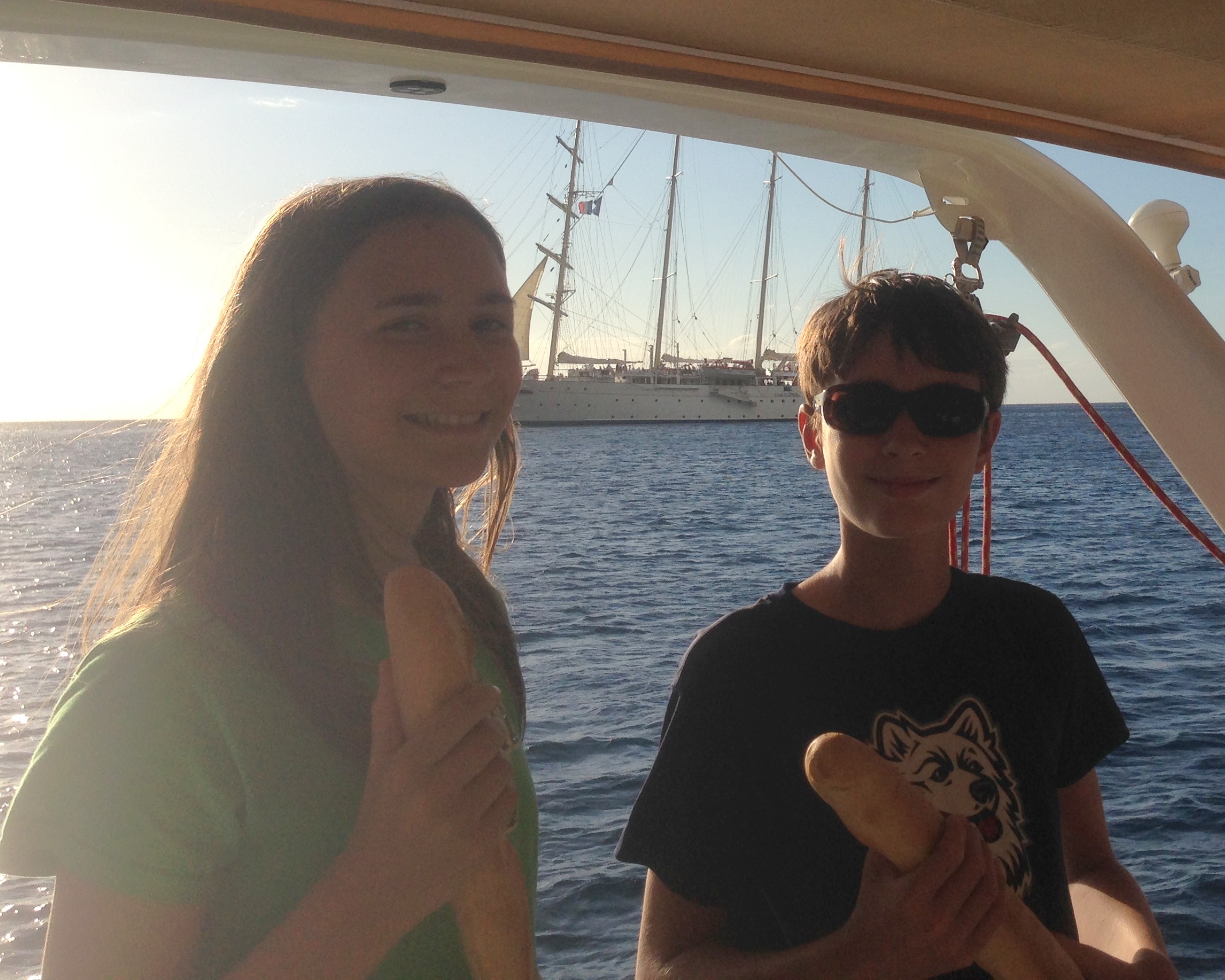
Jerk pork tenderloin with baguettes for Christmas dinner, and chocolate croissants for breakfast! We are fully enjoying our first visit to the French Antilles. Deshais is a colorful and bustling little village stretched out along the eastern shore of the anchorage, which is surrounded on three sides by verdant mountains with nice snorkeling along the northern headland. Colin took a year of French in college, but Kathy Parsons’ French for Cruisers has become the family talisman. We take it with us wherever we go, and we are all practicing. Au revoir for now.
Winter Break: A Visit From the Cousins!
The one thing we miss most from our “regular” lives is spending time with our friends and family. We were lucky enough to have Blaire’s sister Ery, her husband Tim, and their two kids Sage (4) and Reed (2.5) visit for a week after escorting Owen and Megan back to Strider following the crossing to Virgin Gorda from the East Coast.
Science Class Aboard
Most of us are familiar with the fizzy bubbling action that occurs when vinegar and baking soda are mixed, but did you also know that this reaction causes a temperature drop in the liquid? Owen and Megan have just finished a unit on chemistry that culminated in two experiments to discover the interaction between acids and bases. While some homeschoolers use a solution of boiled purple cabbage for their litmus tests, Strider’s scientists have a hand-held pH meter on board, which they also have been using to test water quality in each anchorage (more to come on those findings). Perhaps even more dramatic than effervescing fluid is the effect that vinegar (acidic) has on an eggshell (alkaline). Read their lab report for the full results.
Science Lab Report
Aim:
What happens when you place an egg in a weak acid?
Hypothesis:
If an egg is placed in a weak acid, there will be some kind of change that shows a chemical reaction, such as bubbling (like we saw in the other experiment) because the egg shell is a base.
Materials: List the materials to be used in the experiment.
- 2 cups (same size)
- 1 measuring cup
- 1 cup vinegar
- 1 cup water
- 2 eggs
- 1 sharpie
- pH meter
Procedure:
- Take out plastic cups.
- Label one cup with a V for vinegar and one with a W for water.
- Measure 1 cup of vinegar and fill the V cup with it.
- Measure 1 cup of water and fill the W cup with it.
- Place eggs in cups.
- Make observations each day.
- On the last day, test the pH of water and vinegar and compare it to pH of the liquid in each egg cup.
Observations:
Day 1: The vinegar egg sank to the bottom of the cup. Later in the day it was covered in tiny bubbles. The water egg sank, but had no bubbles on it.
Day 2: The vinegar egg started floating and was still covered in bubbles. It also started expanding slightly. The shell felt a little bit squishy. The water egg remained the same as on Day 1.
Day 3: The vinegar egg sank again, was still covered in bubbles and expanded even further. The shell felt squishy. The water egg remained the same.
Day 4 (final day): The vinegar egg doesn’t have any more bubbles around it and it felt extremely squishy, like it might pop if poked by something sharper than a finger. The water egg remained the same. Then we did pop the vinegar egg and the shell was a gooey mess. It could not hold the egg together.
Conclusions:
During the four days, the eggshell collapsed. The pH of the vinegar cup was higher than the pH of vinegar. I think this is because the eggshell which is a base absorbed some of the acid. Water has a more neutral pH, so the effect was not as much. Maybe the vinegar egg expanded because, since the eggshell was soft, liquid could get in there. I don’t know why the vinegar egg rose and then sank. These results supported my hypothesis, but there more results than I predicted.
Evaluation (ways to improve the experiment and questions that remain to be answered):
- Use larger cups because their size may have limited the expansion of the egg.
- Test the pH of vinegar and water in the cups before the experiment begins. We tested the pH of both the water and the vinegar, but not in the same cups that we used for the test.
- Test the pH of the liquid in the cups each day, not just at the end.
- We should do the observations at the same time each day and maybe more of them.
- Do a test with brown eggs and a test with white eggs to see if the results are different.
- We could test to see what happens if you put in even more vinegar.
- We need to think of a test to see why the egg expanded and a test to see why it sank, rose, and then sank again.
Owen’s Horror Zone
When I went to Savannah Bay in the British Virgin Islands, we traveled to a coral reef and went snorkeling. We saw cool fish like yellow tail snappers, damsel fish, stoplight parrot fish, and blue tang. The kinds of coral we saw were staghorn coral, brain coral and fire coral. I was swimming with my new snorkel gear which was really exciting because I had never used it all at once before. As we were exploring the edge of the reef, my dad found a small passageway between the coralheads that was deep enough to swim through. The passage way led farther into the reef. As we were swimming, we split up to check out interesting fish and coral. I kept swimming farther into the reef when I realized I was in the middle of a deep circle surrounded by fire coral and sea urchins! There was an open passage, but it was too shallow for me to swim through, and I was not able to walk out of the circle because I had my flippers.
I had no choice but to float out of the reef’s death trap. So I put myself in a position that would make me float on the very surface of the water and used flutter kicks to swim against the wind and tide. When I finally got out of the horror zone, I headed back to the dinghy where the others were. It was a long swim, but I did not really care. I was just glad I was out of the passage. As I was getting to the edge of the coral reef, I had a new problem. My mask was filling up with water and my snorkel was clogged. I was kind of bummed, but I did not mind really because I am getting better at clearing them. As I got in the dinghy, I started up the engine while the others worked on pulling up the anchor. After that, we zoomed home.
Megan’s Update
What’s Up?
Recently I have been caught up in many activities which is why I haven’t been able to write on the blog for such a long time. One of the activities has been snorkeling. We have sailed to many different spots where there are large, beautiful reefs. I have seen many fish, such as many varieties of parrot fish, butterfly fish, damsels, sargeant majors (which are my favorite), squirrel fish, trumpet fish, and many, many, more.
We have sailed from The Bitter End in Virgin Gorda to English Harbour, Antigua. There are a lot of boats here, as well as an old British fort from the 1700’s that my mom, brother and I went to see. While we were walking on the trail up to the fort, we saw a mother goat and her two kids. They were adorable! One of the kids kept stopping to just stand in one spot and bleat for a moment, then it would continue after its mother and sibling for a few feet before stopping to bleat again! ADORABLENESS!!!!!!!!!!!!!!!!! The fort was cool also, because it had some old buildings that were perfect place for imaginary play, but a bit spooky because they were empty and dark.
I have also been extremely (and I mean EXTREMELY extremely) obsessed with Harry Potter recently, because HP is one of the most awesome book series in the entire universe! I think what brought me back to being completely obsessed was visiting Universal Studios in Orlando, FL and spending a few days in Harry Potter World. (Thanks to my totally amazing grandmother, Leila, for taking us. THANK YOU!!!!!) I am currently writing two fan fiction stories (made up stories written by fans of a book series/book/movie(s)/tv show etc.). One is called ‘Head Over Heels’ which is a love story that takes place in Harry and the gang’s fifth year, and the other is a second generation story (19 years later) that I have not named yet. 🙂 While I was at The Bitter End, I found a friendly little lizard crawling around on our bags. I was able to pick him up and hold him, it was so cute! I decided to name him Harry. Don’t get it? It’s a joke/play-on-words. In the first book when Hagrid shows up to give Harry his Hogwarts acceptance letter, there is a part where he says “You’re a wizard, Harry!” The joke is supposed to be that it’s as if he said, “You’re a lizard, Harry!” So yeah. Hmmm… explaining a joke kinda takes all the fun out of it…. Oh well!
Other than that I have been making many different foods to pass the time (pumpkin pie, hot pretzels, mac & cheese, brownies and Thai noodles) because it is pretty boring on the boat without any friends and just school work. I miss everyone in my family (if they are reading this then I miss you a lot!) and I am currently in a very long argument with myself over wether I’ve liked the journey so far or not. I love going to new places, but I really dislike sailing. 😦
That’s all for now,
PEACE LOVE HP – Megan
The Passage South
Our apologies to friends and family, but internet connections were spotty in the BVI. More posts are on the way…
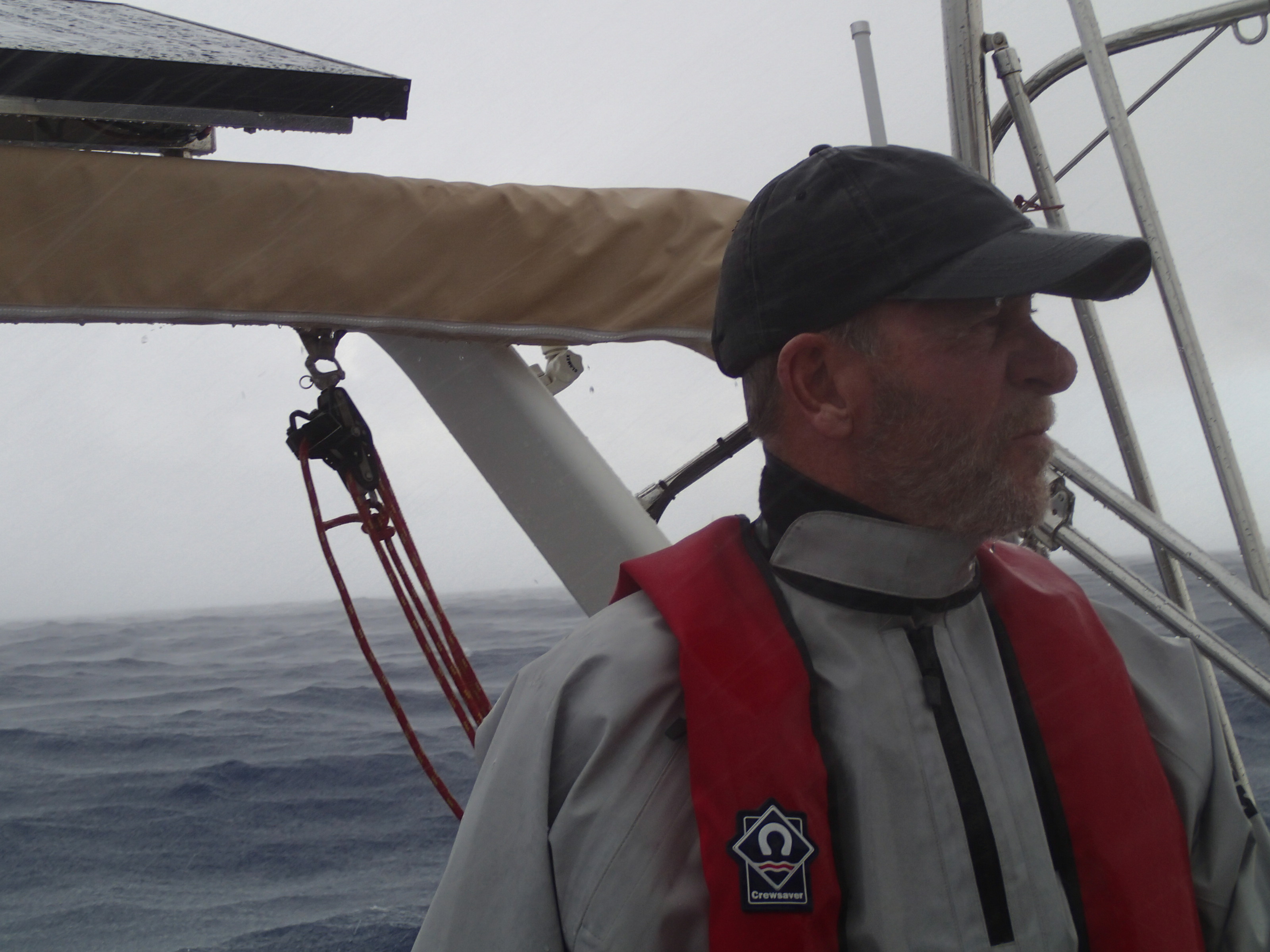
We were scheduled to depart Hampton, Virginia with the Salty Dawg Rally on November 2nd. We were delayed one day by a powerful low pressure system off Cape Hatteras, but once it moved northeast over George’s Bank and the Canadian Maritimes, forecaster Chris Parker declared a “weather window” for boats departing Chesapeake Bay for the Caribbean. Strider set sail on November 3rd with some 60 other boats, clearing Hampton Roads with crisp autumn skies and a fine westerly breeze. We passed Cape Henry and reached southeast along the outer banks. During the night we marked our progress by lighthouse beacons in the distance: Currituck, Bodie Island, and finally Cape Hatteras, our last hint of land for the next 1400 miles.
For this passage Owen and Megan decided to stay ashore with family members, and two hearty sailors joined us in their place. Our insurance company had required that we bring crew members with offshore experience, and we found this in spades. Blaire’s uncle, John Kiley, brought a lifetime of blue water sailing, including a full circumnavigation. Ben Yeager, one of our former Taft students, was already a veteran offshore passage maker at 26 years old, not to mention an expert fisherman. We were ready, and so was the boat. We had sailed Strider over 2500 miles since March, learning its strengths and weaknesses and performing many hundreds of hours of maintenance. Though the “to do” list on a sailboat is never complete, we headed to sea with great confidence in our little ship. 
Our first dawn found us entering the Gulf Stream, and Ben wasted no time tossing out a lure. Within five minutes the reel was hissing, and the fight was on. The fish made four long runs. Ben had to clamp a towel around the rod and line in a desperate bid to keep our gear, as twice his adversary took all but a few inches of backing from the reel. After thirty minutes and many blisters, he finally gained the upper hand, hauling in a beautiful 40 pound tuna. This turned out to be the first of several fish Ben caught during the passage, including a juvenile blue marlin and four Mahi Mahi. With our freezer full of tuna steaks we released all the other fish except a single Mahi Mahi, but the anticipation of another epic fight kept us on our toes for the rest of the passage.
For the next two days we headed SSE, remaining west of a tropical trough with widespread squall activity. At times we made good progress by skirting the edges of rain squalls, but for the most part the winds were light or on the nose. Becalmed on November 5th we swam in 78 degree water, and we grilled tuna steaks on the stern. Early the morning of November 7th the wind finally backed to WSW and filled, and with the trough dissipating we set an easterly course. We did not want to get stuck below the rhumb line when the easterly trade winds filled, which would necessitate beating into wind and waves.
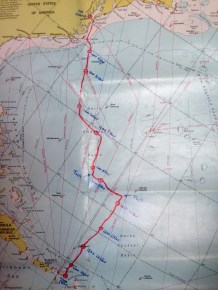
On 10 Nov we arrived at N2615 W6340, 465nm due north of Virgin Gorda, and we tacked onto a southerly course, but no matter how many times we scanned the horizon the easterly trade winds failed to appear. With diesel running low we could not allow the boat to heel more than 15 degrees without sucking air into the line, starving the engine, so we sailed when there was some breeze and motored when there was not. Meanwhile, the North Equatorial Current on our port bow slowed our progress and filled the sea with sargassum, which wrapped itself around our rudders and fishing lures. We took consolation in the knowledge that the other Salty Dawgs were facing the same conditions, and many of them remained to our north and west.
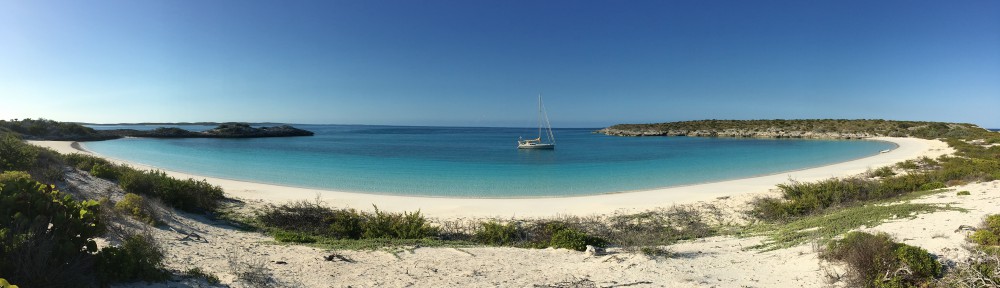
Finally, the afternoon of November 13th, a mere 60nm north of Virgin Gorda, we exited the current, and as the sargussum cleared a light easterly trade wind began to fill. Setting the gennaker we were soon moving briskly on a close reach. At 2000 we sighted the lights of Tortola, and at 2230 we passed the west end of Anagada. We crossed Sir Francis Drake Channel making 7 knots under the moon and stars, entering Gorda Sound and dropping anchor at 0140 on November 14th. By mid-morning the next day we had cleared customs and picked up a mooring at the Bitter End Yacht Club. Unsure how to prioritize things, we simultaneously went about making boat drinks, airing out the boat, and diving into the 80 degree water, all with equal enthusiasm.
For all the time we spent before our passage contemplating heavy weather and at-sea emergencies, our 1400 mile sail proved pretty placid. We tested our fuel management skills more than our sailing abilities. So, was it boring? Not really. For one, after the initial 48 hours we settled into our four-hour watch routines, which kept us busy either working or sleeping. Some of our biggest challenges were in the galley. A chicken pot pie inconveniently adopted the consistency of chicken soup, which a wave slopped out of the casserole dish and into the silverware drawer, filling it with broth and potatoes. More problematically, tuna blood leaked from ziploc bags in the refrigerator, and after two days the blood turned rancid. The foul smell pushed Colin over the edge, and he was relegated to staring at the horizon and occasionally throwing up over the side until John volunteered to disinfect the refrigerator with boiling water and bleach.
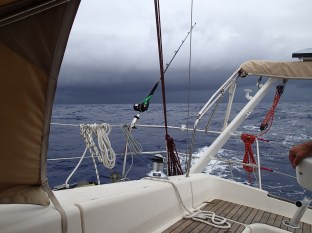
As expected on a longer passage, we also faced some minor mechanical issues. Lines chafed, water filters clogged, and the depth sounder shorted out. Most critically, our first night at sea the steering cables jumped the shivs when we snagged a heavy, industrial-sized plastic bag with our port rudder. After disconnecting the wheel from the rudders we elected to continue under autopilot and emergency tiller. John found that the fish gaff served as a perfect tiller extension, and we spent many hours hand steering. This not only proved our “saltiness,” but it also helped us feel the boat’s balance and prepared us in case the autopilot failed, though this never happened.
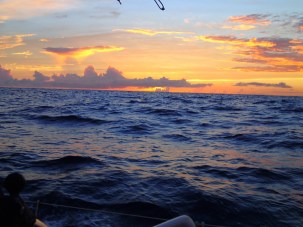
Fortunately, the challenges were more than offset by the uplifting moments. We witnessed many a beautiful sunrise and sunset, along with sightings of rainbows, turtles, and porpoises. We all saw the green flash, and John spotted it twice. We were treated to a moonbow, with all the colors faintly visible in the darkness. During a rain squall with lumpy, confused seas, an especially playful pod of dolphins visited us. They seemed animated by the conditions, as they repeatedly leapt at our side throughout the squall. On another occasion we were visited by dolphins on a moonless night. As they swam alongside the cockpit we could hear them breath, and we could dimly perceive their shapes by starlight and phosphorescence in the water.
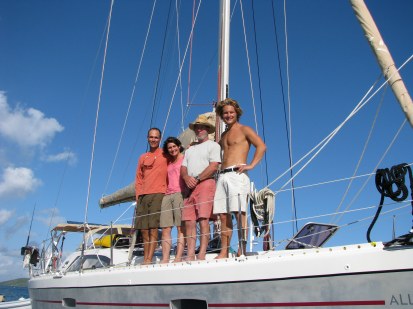
The biggest treat of our passage was simply spending eleven days with a great crew. Everyone pitched in, no one ever complained, and we lifted each others’ spirits with good humor. John showed a knack for finding great music on late-night AM radio shows from Cuba and the DR. Ben told stories about his adventures sailing in Greenland and wrote hilarious chapters for his upcoming novel, reading them aloud to our delight. Blaire and Colin simply enjoyed being part of the crew while taking a break from their parenting roles. We will not hesitate to sail another long passage if we can hand pick a crew like this one. A big thanks to John and Ben, and thank you to grandmother Sheila and aunts Ery and Galen for making it all possible!
We’re Headed to the Caribbean!
Tomorrow we leave Hampton, VA to sail to the Bitter End on Virgin Gorda, the largest of the British Virgin Islands. We expect a 10-12 day passage. You can track our progress via the following link: http://share.findmespot.com/shared/faces/viewspots.jsp?glId=02AKcuCl19K5ETp6ZXYN0jFS70Nk5U5Mp
Our Destination:
Autumn Winds and Foliage
The recent nor’easter provided swift sailing, but after a full day of wind and rain we decided to anchor in the shelter of Mill Creek, Virginia. The next morning, as the rain moved off towards the northeast, it was replaced by cold, dry air from the northwest. At the same time, Owen found autumn colors along the shore. It was a beautiful spot, but the harbingers of fall reminded us to keep moving south.